Don’t mind the dead body in the back.
Katherine Blomiley wasn’t one to let a little thing like a corpse deprive her of liberating customers from their ill-gotten gains. Not even her mother-in-law’s. Allegedly.
Blomiley kept an alehouse in Chorlton in the mid-17th century. And it was here that she was charged with ignoring her recently deceased in-law in favour of continuing the revelry with her guests. One of many accusations which threatened her ability to work. You see, a 1522 Act created a national licensing system in England and Wales (though local ones had been in existence in some forms previously). This license meant that only those approved by the local Justices of the Peace could brew and sell ale, and to get this permission they had to agree to certain… standards of behaviour. Including, abiding by rules, maintaining a good reputation, and generally behaving oneself. Naturally keeping a party going with a dead relative in the house was frowned upon. And could have cost Katherine her livelihood.
Of course, Blomiley spoke up in her own defense. She contested that her husband had recently died, leaving her a widow with no manner with which to provide for her children. With little in the way of jobs and the local trades in decline, she turned to brewing and selling ale to keep her kids out of poverty. For this she was later arrested and sent to jail. She, being that cunning woman that she was, found a loophole, and her father was granted a license instead, though it was really her who was doing the brewing and selling ale.
Blomiley is one of many women who found themselves running afoul of the licensing law and accused of all manner illegal, or ‘immoral’, shenanigans in an effort to revoke their licenses. And like her, women fought back against these charges, with mixed results. Men could use such a system to knock out their competition, or settle scores, or simply avoid their own responsibilities. As is the case with Nicholas Halliwell who in 1667 maligned Anne Core’s character in an effort to have her license pulled after she tried to recoup money she had lent him. To be clear, it wasn’t always men who tried to get women’s license revoked, women too used this system. In any event, maintaining your license in the 16th and 17th centuries could be quite precarious. Reputation was everything, and a few well-placed lines and you could, as Blomiley and Core did, find yourself in front of the court defending your right to your business. A business which just narrowly kept you and yours out of poverty.
It was Joshua Taylor and John Harrison who sought to have Blomiley’s license revoked, bringing her before the Justices and accusing her of all manner of ‘miscarriages’ she had apparently committed. A laundry list of charges, which included serving booze on Sundays whilst people should be attending mass, entertaining ‘thieves and vagabonds’, allowing gambling at ‘unlawful hours’, harbouring stolen goods, no stables for horses, playing music at ‘unseasonable times’ and even, horror of horrors, having accommodation for her human guests that was deemed ‘not convenient’. Will the terrors never cease. Oh, and of course, the whole corpse thing.
Other charges women faced were cursing, fighting, gambling and general immoral behaviour.
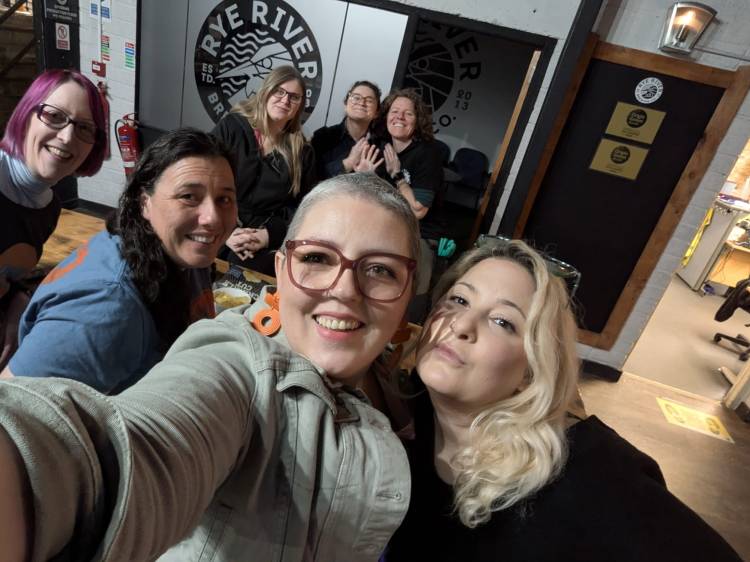
So naturally, when the Beer Ladies Podcast ventured up to the Rye River Brewing company to sample an International Women’s Collaboration Brew Day beer, we had to see if we could manage to piss off the ghosts of Taylor and Harrison. For science, you see.
Held on March 8th, International Women’s Collaboration Brew Day, or IWCBD, is an incredible annual event where, according to their website, women come together all over the world to brew beer, ‘celebrate women in the beer industry, and to create and release collaboration beers inspired by a central theme, raising funds for women’s causes’. Both homebrewing and larger scale brew days are encouraged. IWCBD is now organised by Women on Tap CIC with the theme for 2026 being Unite Belonging.
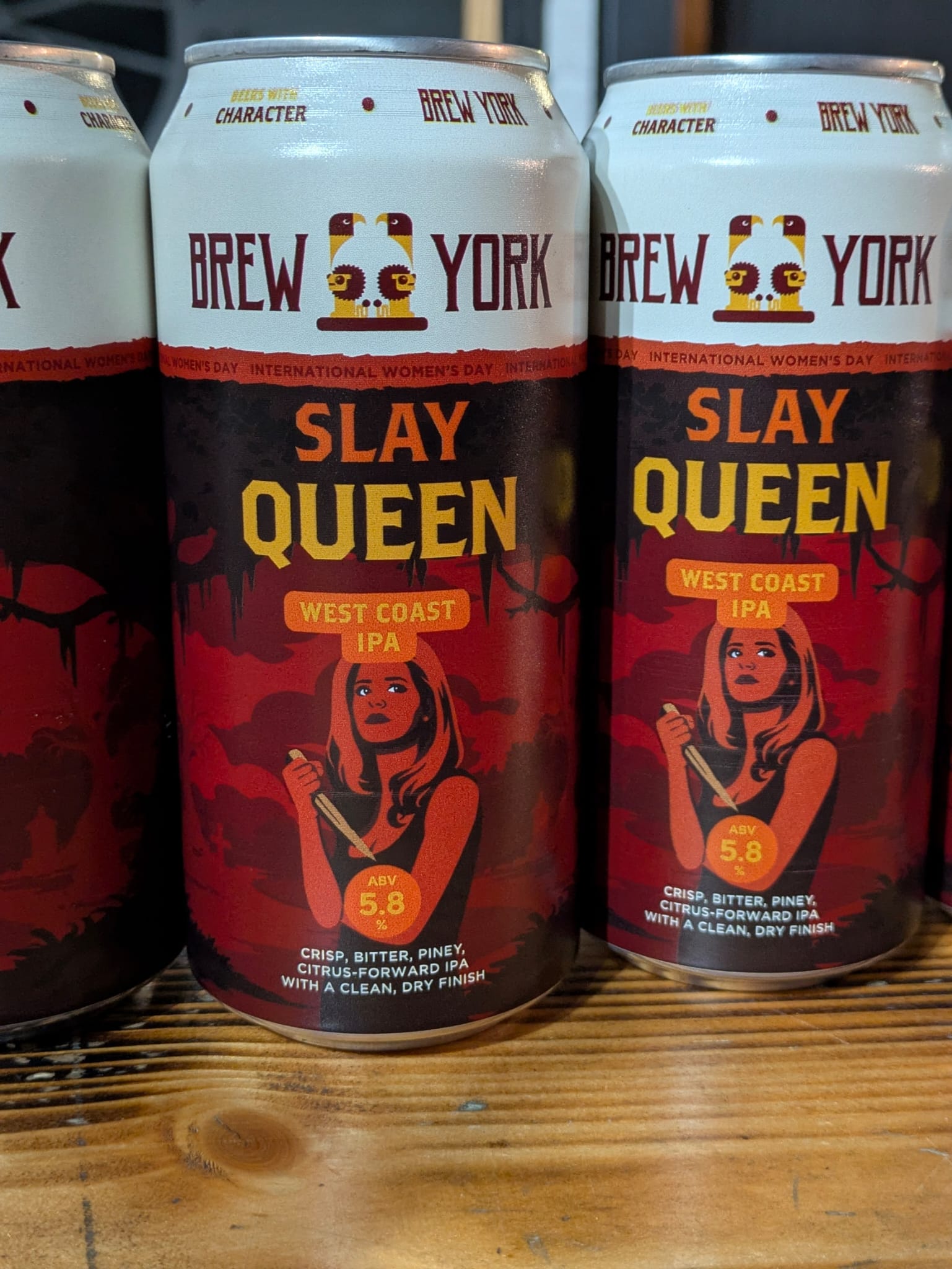
This is an amazing and important event and we were so honoured when Sarah of Rye River Brewing Company invited us up to to sample the IWCBD beer she had helped make at Brew York – Slay Queen. A Buffy The Vampire Slayer inspired West Coast IPA, from their website: ‘Inspired by Buffy the Vampire Slayer, it’s a tribute to strength, independence and taking on the darkness head-on (stake optional)’. And what a beer it was. Clocking in at 5.8% with hints of citrus and resin, this beer packed a delicious punch.
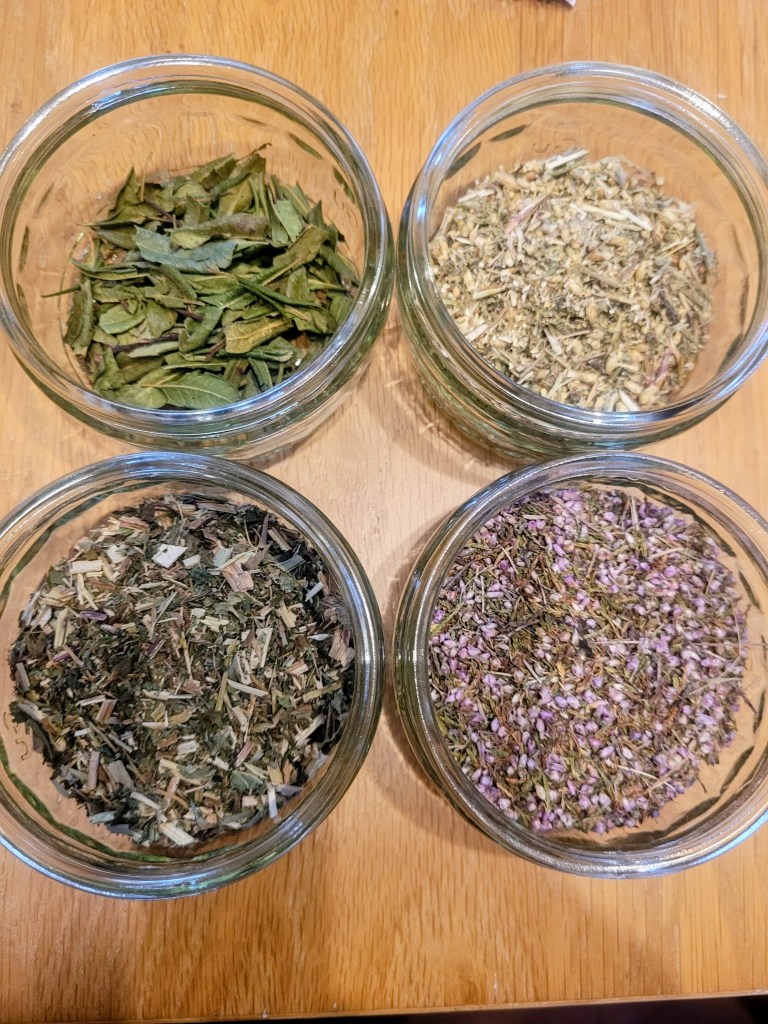
But simply sipping didn’t seem quite enough of a tribute, not only to the incredibly pop icon that is Buffy, but also to all those alewives who came before us. We needed more rule breaking. I was inspired by another brew day from 2024 when I, along with my friends Chelsea and Charlotte, flew to Edinburgh to meet with the awesome women of Closet Brewing, Lucy and Lizzie Stevens. We created ‘Ladies of the Meadow’ an ale made using meadowsweet, yarrow, and heather flowers, all herbal additives I found when researching Scottish beers. This collab was for my first book The Devil’s In The Draught Lines: 1000 Years of Women in Britain’s Beer History. But we also added a twist to our brewing, we tried to get our license taken away by doing all those things women in the past had been accused of. Instead of viewing Katherine Blomiley’s list of charges as things that should have be avoided at all costs, we viewed them as a must do list.
So we invoked the same method at Rye River, we gambled, we cursed, we pretended to box. At Closet we harboured a particularly adorable four-legged fluffy dog as our designated thief, at Rye River we simply swiped each others snacks. We played unseasonable music- The Monster Mash seemed apt. And of course neither establishment had a stable for horses. And when we attended Rye River it was a Sunday, so that worked out perfectly for us. But what to do about acquiring a dead body. Preferably an in-law.
And the answer to that, obviously, is ghost hunting. Quite conveniently Rye River is haunted, and I possess on my phone a super duper sophisticated not-at-all-a-gimmick ghost hunting app. So we patrolled around the taproom area hunting for clues and we rewarded when we learned that the premises are in possession of a kindly spirit, who has been around for a long, long time, and wishes to bring luck to the brewery. And 1000000% completely real and factual. Not at all a made up thing by the app in question. Definitely not. Nope.
Regardless, I’m sure our 17th-century Justices of the Peace would be decidedly enraged by our shenanigans. Perfect.
All and all it was a lovely day out at Rye River celebrating Women’s Day and IWCBD with some of favourite living humans, and irritating some of my least liked dead ones. And whilst I am being rather glib about Katherine Blomiley’s struggles against her male accusers, I want to be clear that we don’t actually know the truth of the matter. And two things can be true at once, she could very well have been up to no good, whilst also needing the money to support her family. She might even have actually had to engage in these behaviours to maintain her clientelle. I don’t know the answer.
More to the point, many women would find themselves on the wrong side of these accusations for a variety of reasons, some because they were true, others like Anne Core, because the men in their lives were weaponising the patriarchal laws and standards that overwhelmingly disenfranchised women. So whilst it is funny for us now to thumb our noses up at this distant authority, it was a very real threat to women in the 16th and 17th centuries. Much like other issues plague us today. If you are interested in exploring this further, I dive deeper into this in my aforementioned book The Devil’s in the Draught Lines, and of course more recently, in an Irish context in Filthy Queens: A History of Beer in Ireland. Hence the Slay, (Filthy) Queen (s) title of this work.
Now, if any other breweries, or pubs, or other beer adjacent enterprises – we aren’t fussy, find themselves haunted and in wont of a proper ghost hunting team, the Beer Ladies would be happily on the case.


Phil
I’m curious about the dead body tho. Also about the Chorlton connection – Chorlton as in -cum-Hardy, south Manchester? Didn’t think there was anything there that early.
LikeLike
braciatrix
Me too! Not sure precisely about Chorlton, I shall circle back
LikeLike